
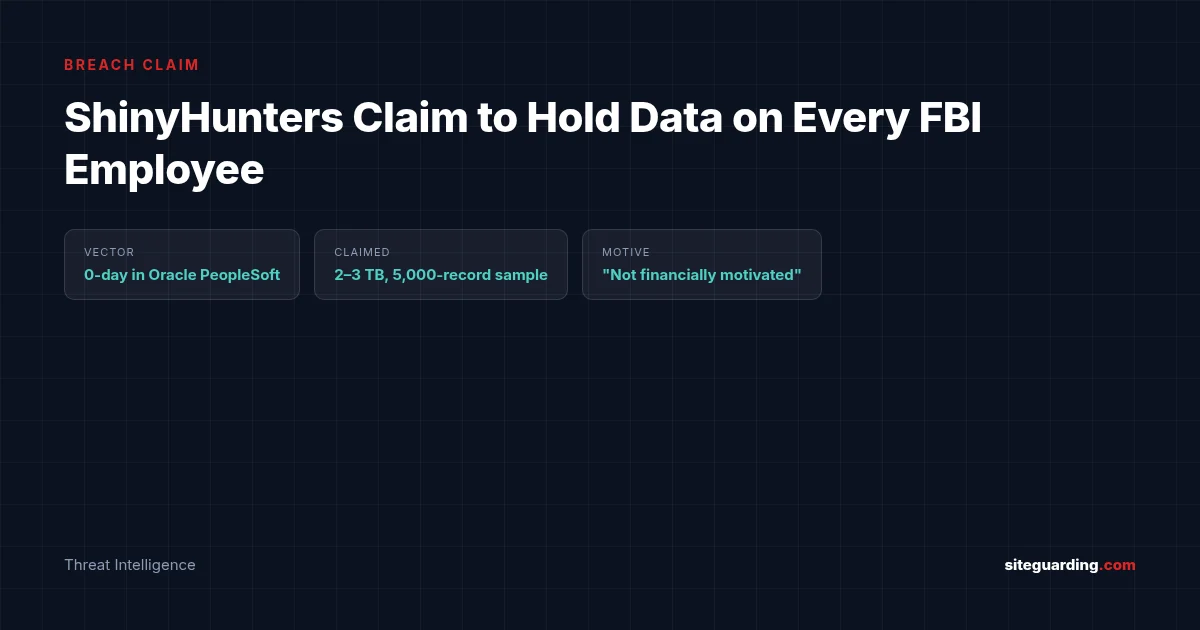
Late Monday night, a group calling itself ShinyHunters defaced the FBI’s own jobs site and claimed to be sitting on personal data for every current and former employee of the bureau, plus everyone who ever applied to become a special agent. No confirmation from the FBI has landed yet, so this is still a claim, not a confirmed breach, and the honest version of this story has to hold both things at once: some of what’s been shown checks out, and a lot of it doesn’t yet.
What the group says happened
According to ShinyHunters, they found a zero-day in Oracle PeopleSoft, the system the FBI uses to run HR administration and process job applications, and used it to reach servers sitting in AWS GovCloud, the cloud environment US government agencies use specifically because it carries tighter controls for sensitive data. From there, the claim is straightforward: they pulled everything, somewhere between 2 and 3 terabytes of files covering current employees, former employees, and special agent applicants.
The data types listed are names, home addresses, phone numbers, spouse information, and dates of birth. That’s not the combination you need for financial fraud. It’s the combination you need to find someone’s house and know who lives there with them.
What journalists could actually verify
The group sent a 5,000-record sample to reporters. Some of the phone numbers in it were run through OSINT Industries, an open-source intelligence tool, and they matched the names attached to them, so the sample didn’t look randomly generated. Separately, a tool called Darkside tied a portion of those numbers to personnel at the US Department of Justice, the parent agency the FBI sits under. None of that confirms the full 2-to-3-terabyte claim. It does mean at least part of the sample is real data belonging to real people, not a fabricated attention grab.
“This is not financially motivated”
One quote from the group is worth pulling out on its own, because it breaks from the usual script: a representative said the attack “is not financially motivated,” and that whatever comes next “is not something I’d call extortion, maybe coercion.” ShinyHunters’ normal pattern is the standard one, break in, then threaten to publish unless paid. Walking away from that framing upfront leaves a much worse read available: contact information, home addresses, and family details for FBI personnel aren’t obviously useful for a payday. They’re useful for finding someone.
Our take
Two separate questions are getting collapsed into one headline here, and they shouldn’t be: did someone breach the FBI, and did real data on real people leak. Based on what’s public, the second looks more likely than the first is confirmed. ShinyHunters didn’t necessarily punch through the bureau’s core defenses in the classic sense, they may have reached a supporting HR system that could sit in a contractor’s cloud environment and be logically distant from the FBI’s operational infrastructure. For the person whose phone number just leaked, that distinction means nothing. For sizing up the actual incident, it means a lot.
The vector itself is the part every business, not just a federal agency, should sit with: a vulnerability in Oracle PeopleSoft, an old but still widely deployed HR and ERP product. Systems like this rarely get the same security attention as a public-facing website or a customer login page, and what they hold is precisely the personal and employment data that makes an attack like this worth running in the first place. The more “background” a system is treated as, the less scrutiny it gets, and the more attractive it quietly becomes.
What to actually do about it
- If your organization runs an HR system, an applicant portal, or any similar “internal” web application, don’t assume it’s out of scope just because customers never see it. These systems fall out of the regular security review cycle constantly, precisely because they’re treated as background infrastructure.
- Get a real penetration test that covers your HR, employee, and applicant-facing systems specifically, not just the public website customers interact with every day.
- If the system in question is a customer- or employee-facing web application built on any modern framework, web application penetration testing that goes past the login page is what actually finds this class of issue before someone else does.
- For the wider infrastructure and network perimeter around any system holding employee personal data, website penetration testing services cover exactly the kind of exposure that turns a background system into a headline.
- If you already suspect something similar may have happened to your organization, don’t wait for confirmation before acting. Get it checked, understand the real scope first, and decide what to communicate second.