
Defend your website against brute force attacks, automated password cracking, and unauthorized admin panel access. Our advanced anti-bruteforce solutions work with WordPress, Joomla, Magento, and any custom CMS.
Of hacking-related breaches involve brute force or stolen credentials
Credential stuffing attempts blocked annually worldwide
Time to crack an 8-character password with modern hardware
Login attempts per day on a typical unprotected WordPress site
A brute force attack is the most common type of attack used against web applications and online services. The primary purpose of this attack is to gain unauthorized access to user accounts by repeatedly attempting to guess the password of a targeted user or group of users. If a web application does not have any protective measures against this type of attack, it becomes relatively simple for hackers to compromise the entire system.
This method of password guessing is effective because, given enough time, the password will eventually be cracked — but the process may take a very, very long time depending on complexity. For modern computers, cracking passwords containing up to 8 characters that consist mainly of letters or numbers is very fast, often taking only minutes or hours. Therefore, weak passwords like qwerty, 1234321, or 12passw21 should never be used for any online account, especially website admin panels.
These common passwords can be cracked in seconds by automated brute force tools:
At present, a truly secure password should contain 10–12 characters minimum, including uppercase and lowercase letters as well as special characters such as ~!@#$% and others. It is highly recommended to change your password at least once a month — this disrupts the sequence of brute force guessing and significantly increases the likelihood that your newly created password has not yet been tested by malware or automated hacking tools.
If a person fails to comply with these minimum security rules, they put themselves at great risk. By gaining access to just one service, an attacker can easily find access to other personal data, email accounts, banking information, and additional online services — especially when the same password is reused across multiple platforms. This is known as credential stuffing, and it represents one of the most dangerous consequences of a successful brute force attack.
SiteGuarding provides a simple and highly effective solution against brute force attacks. Our anti-bruteforce technology is designed for website owners who need reliable, enterprise-grade protection without the complexity of traditional security configurations. Whether you run a small blog or a large e-commerce platform, our solution scales to meet your needs and provides advanced web protection against all types of automated login attacks.
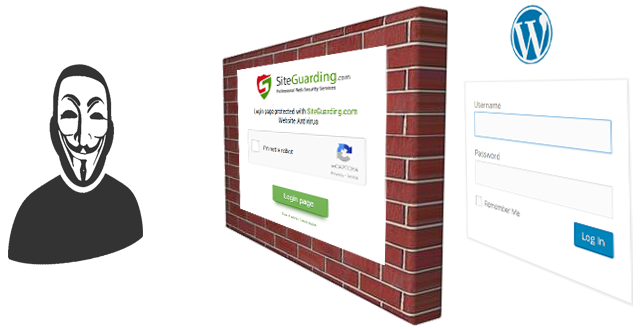
Our brute force protection module intelligently detects and blocks suspicious login attempts in real time, preventing automated bots and hacking tools from accessing your website's admin panel, user accounts, and sensitive areas. The system works transparently for legitimate users while creating an impenetrable barrier against malicious traffic.
Built for performance and reliability, our anti-bruteforce solution provides comprehensive login security for any website platform without impacting server performance.
Comes with ready-made extensions for WordPress and Joomla. Can also be deployed on any custom-developed website with minimal configuration. No coding expertise required.
Our protection module effectively blocks all types of automated bots, credential stuffing scripts, dictionary attack tools, and advanced hacking frameworks that target login pages and authentication endpoints.
Compatible with shared hosting, VPS, dedicated servers, and cloud infrastructure. Our solution works perfectly even on very slow or busy shared servers, ensuring reliable protection regardless of your hosting environment.
No database required — our solution does not use MySQL or any database engine. This means extremely low server CPU usage and zero impact on your website's performance, even under heavy brute force attack conditions.
Understanding the different types of brute force attacks helps you recognize the importance of comprehensive login security and advanced web protection for your website.
The attacker systematically tries every possible combination of characters until the correct password is found. While time-consuming, this method guarantees eventual success against short or simple passwords that lack complexity.
Instead of trying all possible combinations, the attacker uses a pre-compiled list of commonly used passwords, words, and phrases. This method is significantly faster and highly effective against users who choose predictable or dictionary-based passwords.
Attackers use username-password pairs leaked from other data breaches and attempt them on your website. Since many users reuse passwords across multiple platforms, this attack has an alarmingly high success rate.
Rather than targeting a single account with many passwords, the attacker uses one commonly known password and tries it against many different usernames. This is especially dangerous on websites with default admin accounts like "admin" or "administrator."
A combination of dictionary and brute force methods. The attacker starts with dictionary words and then applies character substitutions, appending numbers and special characters to each word, creating a more sophisticated and targeted password-guessing strategy.
Uses a botnet — a network of compromised computers — to distribute login attempts across thousands of IP addresses. This makes traditional IP-based blocking ineffective and requires advanced security monitoring and behavioral analysis to detect.
With over 15 years of experience in enterprise website security, SiteGuarding delivers proven brute force protection trusted by thousands of businesses worldwide.
Our systems monitor login activity around the clock, instantly identifying and blocking suspicious patterns before attackers can gain unauthorized access to your website or admin panel.
Our lightweight, database-free architecture means your website loads just as fast with protection enabled. No MySQL queries, no server overhead — just seamless, invisible security.
Whether you use WordPress, Joomla, Magento, Drupal, OpenCart, or a custom-built website, our brute force protection integrates seamlessly with your existing platform and server configuration.
Follow these essential steps to build a robust defense against brute force attacks and keep your website, user data, and business operations safe.
Use complex passwords with 10+ characters, mixing uppercase, lowercase, numbers, and special characters. Change passwords monthly.
Add two-factor authentication to your admin panel. Even if a password is compromised, the attacker cannot access the account without the second factor.
Deploy SiteGuarding's anti-bruteforce module on your website. It blocks automated attacks in real time with zero performance impact.
Use security monitoring dashboards to track login attempts, blocked IPs, and attack patterns. Stay informed and react to emerging threats proactively.
Common questions about brute force attacks, password security, and how SiteGuarding protects your website from unauthorized access attempts.
A brute force attack is a trial-and-error method used by attackers to guess login credentials, encryption keys, or hidden URLs. The attacker submits many passwords or passphrases with the hope of eventually guessing the correct combination. It is the most common attack type against web applications and can be automated using specialized hacking tools and botnets.
The time varies dramatically based on password complexity. A simple 6-character password using only lowercase letters can be cracked in seconds. An 8-character password with letters and numbers may take a few hours. However, a 12-character password using uppercase, lowercase, numbers, and special characters could take millions of years to crack — making password complexity your first line of defense.
Yes. Our anti-bruteforce solution comes with ready-made extensions for WordPress and Joomla, and can also be deployed on any custom-developed website. It works seamlessly with Magento, Drupal, OpenCart, PrestaShop, and virtually any PHP-based CMS or web application.
Absolutely not. Our solution requires no database and uses virtually zero CPU resources. It is specifically designed to work on even the slowest shared hosting servers without any noticeable impact on website loading speed or user experience. In fact, by blocking malicious bot traffic, your server will have more resources available for real visitors.
Yes, our basic anti-bruteforce protection module is absolutely free and included with our website antivirus solutions. For businesses requiring advanced enterprise website security features such as distributed attack protection, real-time security monitoring dashboards, and dedicated support, we offer premium plans with additional capabilities.
If your website has been hacked through a brute force attack, contact our security team immediately. We provide emergency malware removal services, complete website cleanup, backdoor elimination, and post-incident security hardening to ensure your site is fully restored and protected against future attacks.
Don't let automated bots and hackers compromise your website. Get SiteGuarding's free anti-bruteforce protection and secure your admin panel, user accounts, and business data today.